


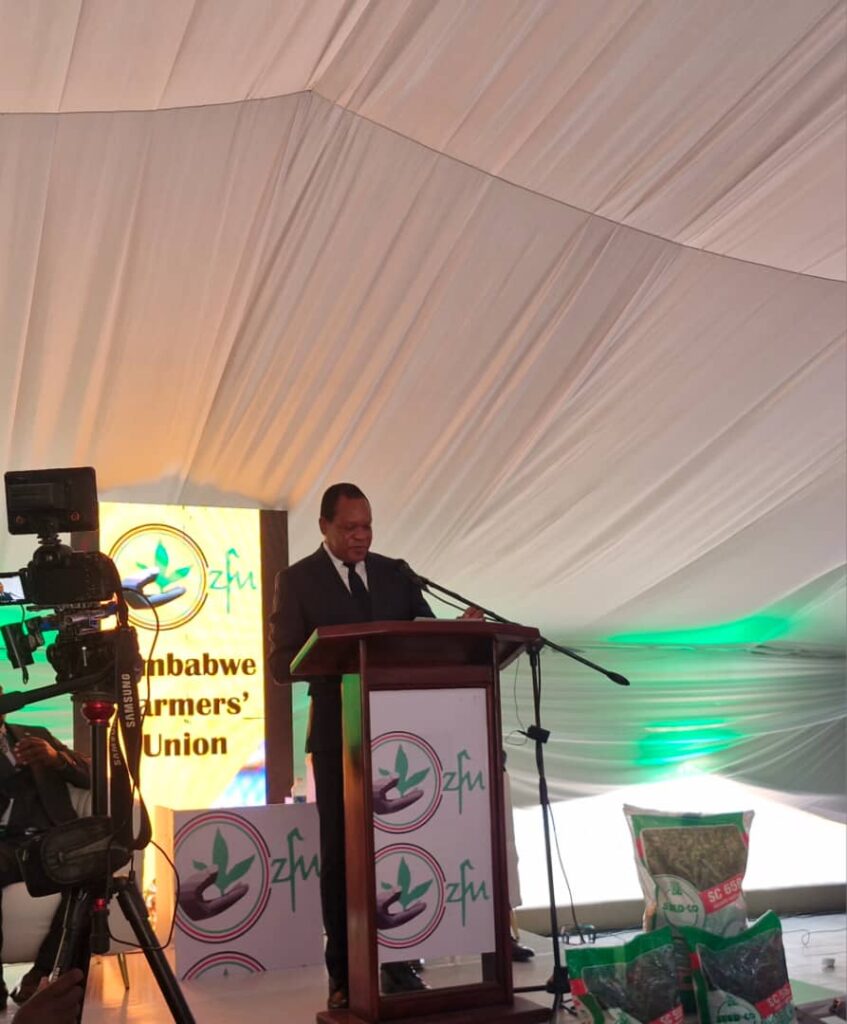
Blessing Nduku The Government has called on farmers to embrace innovation and climate-smart farming methods as Zimbabwe prepares for a potentially difficult 2026/27 agricultural season. Speaking at the Zimbabwe Farmers Union (ZFU) 86th Annual Congress at The Village Lodge in Gweru, Minister of Agriculture, Mechanization and Water Resources Development Dr A.J. Masuka said innovation was
Blessing Nduku
The Government has called on farmers to embrace innovation and climate-smart farming methods as Zimbabwe prepares for a potentially difficult 2026/27 agricultural season.
Speaking at the Zimbabwe Farmers Union (ZFU) 86th Annual Congress at The Village Lodge in Gweru, Minister of Agriculture, Mechanization and Water Resources Development Dr A.J. Masuka said innovation was becoming increasingly important as the country faced the possibility of below-normal rainfall.
The congress is being held under the theme “Harnessing Innovation for Resilience”, a theme which Dr Masuka said was important in helping farmers deal with difficult seasons.
He said agriculture remained one of the most important sectors of the Zimbabwean economy and was the country’s main defence against hunger.
“Agriculture remains the largest employer in Zimbabwe and serves as our primary defence against hunger.”
He said every bag of grain produced on communal land, A1 and A2 farms and commercial farms contributed to household food security and economic growth.
The Minister said Government shared the ZFU’s vision of creating a resilient, commercialized, and viable agricultural sector, adding that the vision would be used as a measure of progress in agricultural development.
However, Dr Masuka said farmers continued to face high production and compliance costs while having limited control over the prices of their produce.
He said farmers were still largely price takers despite bearing the major costs of producing agricultural goods.
Farmers also face a number of charges and fees, including development levies, land unit charges, environmental penalties, veterinary and permit fees, toll fees, licensing costs and taxes.
Dr Masuka said the government had already approved reductions in several agricultural fees and levies and was continuing to introduce reforms to make it easier for farmers to do business.
He said reducing the costs farmers face was important because they needed more resources to invest in new technologies and farming methods.
The Minister also warned farmers to prepare for possible El Niño conditions during the 2026/27 farming season.
According to the speech, meteorological services have warned of a strong possibility of El Niño conditions, with below-normal rainfall expected during the season.
Dr Masuka said climate change could have a major effect on rain-fed agriculture if farmers did not adapt.
“If left unchecked, climate change could reduce our rain-fed maize yield by as much as a third by mid-century.”
He said innovation was therefore no longer simply an option for farmers but had become necessary to maintain production during periods of poor rainfall.
To prepare for the coming season, the Ministry has activated a National Drought Plan focusing on grain reserves, climate-smart agriculture, financing, livestock protection, food imports and early warning systems.
Dr Masuka said Government was working to rebuild the country’s strategic grain reserves before the season rather than waiting for shortages to develop.
The Government is also accelerating the implementation of Pfumvudza/Intwasa and other conservation farming practices to help farmers produce crops even during periods of poor rainfall.
Measures are also being put in place to support livestock farmers through supplementary feed, water points and animal health services.
Where local production is unable to meet national demand, the Government plans to prepare for grain imports in advance to help maintain a stable food supply.
Dr Masuka said early warning information should reach farmers, village heads, headmen and chiefs so that farmers could make timely decisions about planting.
He said the ZFU was represented in three areas of the National Drought Plan: the strategic grain reserve, imports, and coordination and early warning systems.
The Minister said Government was also working on longer-term measures to make agriculture more resilient.
He said the Pfumvudza/Intwasa program was being expanded from about 718 000 hectares last season to a target of 1 million hectares in the coming season.
The expansion, he said, would focus on proper preparation of planting basins, mulching, and timely planting, rather than simply increasing the amount of land under cultivation.
Government is also working to reduce the country’s dependence on rainfall through irrigation development.
Through the Agricultural and Rural Development Authority and the Vision 2030 Accelerator Model, the government aims to irrigate nearly 500 000 hectares of land by 2030.
Dr Masuka said the irrigation schemes would be developed through joint ventures in which communal, A1 and A2 farmers would have a stake.
He also highlighted the growing use of technology in agriculture, including artificial intelligence, satellite imagery and drones.
The technologies can help detect pest outbreaks and provide information on planting plans suited to specific wards.
Dr Masuka said these technologies were being made available to more than 6 000 agricultural extension officers who work directly with farmers.
He said the recent Zimbabwe International Trade Fair and the ZAS Harare Agricultural Show had also demonstrated the growing role of technology and innovation in agriculture.
The government is also working to strengthen local seed and input production, including tissue-culture seed potato production, certified local seed systems, and biological alternatives to imported agrochemicals.
According to Dr Masuka, strengthening local production would help reduce farmers’ dependence on external factors such as exchange rate changes and border closures.
The Government has also introduced new import levies on maize, soybeans, soya meal and wheat, with the proceeds expected to go towards the Agricultural Revolving Fund.
The fund will support irrigation and farmer development and is intended to help local farmers gain better access to markets.
Dr Masuka said provincial and district production targets for the coming season had already been established, but warned that the targets would only have an impact if new farming methods and technologies reached farmers at ward and village level.
He urged the ZFU Congress to hold the Government accountable for ensuring that innovations were implemented on the ground rather than left only in demonstration plots.
The Minister also called on the private sector and development partners to work with Government to strengthen Zimbabwe’s agricultural sector.
He acknowledged that Government did not have the financial resources to independently mechanise, irrigate and digitise the entire agricultural sector.
He said partnerships would therefore be important for building farmers’ resilience.
Dr Masuka urged farmers to assess the conditions they face and change their farming approaches before losses occur.
He expressed confidence that Zimbabwean farmers could adapt to difficult seasons and use innovation to protect their production.
The Government looked forward to the resolutions of the ZFU Congress and hoped that they would provide practical measures that could be implemented beyond the congress.
Dr Masuka officially opened the Zimbabwe Farmers Union’s 86th Annual Congress, which brought together farmers, Government officials, business leaders and other stakeholders in the agricultural sector.
The congress is expected to provide a platform for farmers and stakeholders to discuss the challenges facing agriculture and ways to build a stronger, more resilient sector.


















Leave a Comment
Your email address will not be published. Required fields are marked with *